

Agri-Business
Tuesday, April 22, 2014
Sparse investment limits farming
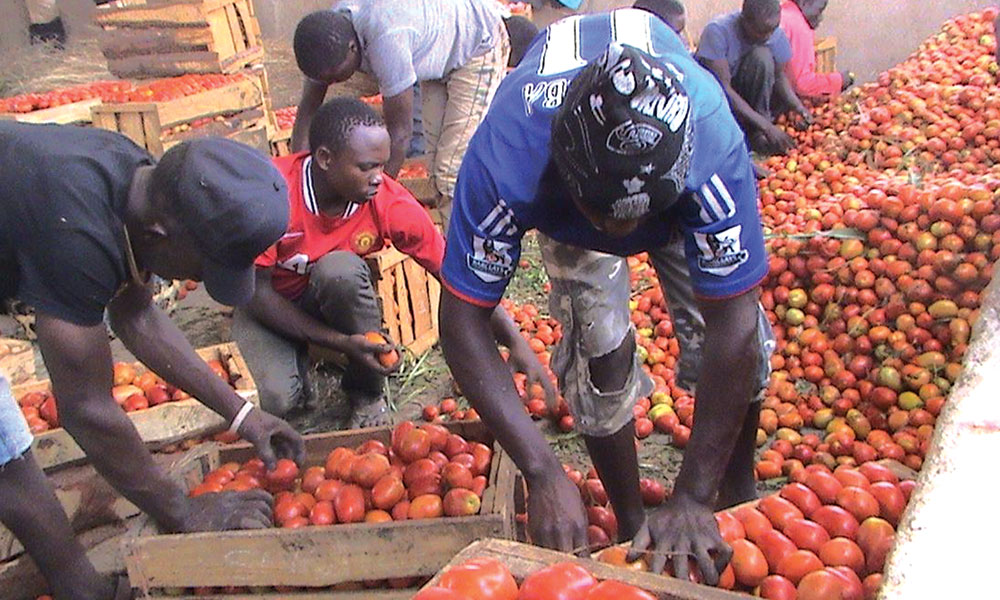
ABUNDANCE: Farmers can grow plenty of foodstuffs under the right circumstances but they need suppot in terms of improving quality.
DAR ES SALAAM, Tanzania – Agricultural productivity growth rates in the East Africa region has lagged behind the rest of Africa and the world at large, due to lack of proper investment.
Regional farmers get headaches when they think about applying for loans to fund their projects. The difficulties are compounded by crops diseases, climate change and lack of high quality seeds.
A smallholder farmer at Kwasunga in Korogwe, Tanga along the highway which links Dar – Arusha and the neighboring country Kenya, Hamida Munishi said she is real struggling to have her earning through farming due to poor harvest.
Munishi says she has to work up early in the morning everyday to rush for her farm before the sunrise because she is still depending on rainfall.
“If, I won’t work up in the early hours, I will not be able to work efficiently in my farm because the sunrise will be high as the land will become dry,” the 45 years old expressed her grief.
When asked by East African Business Week, why she doesn’t change into irrigation farming she said, she is aware about the benefit of irrigation farming, but funding is a bit challenge for her.
She said, they were first being advised to form groups so as to work as a team and they do manage boost their farming but market become another challenge.
“Even if I will be able to secure loan, whether from the bank or someone else, still I will not be able to pay back, this is because we don’t have reliable market for our products,” she noted.
Munishi is one of the millions farmers in the country and East African region at larger who have been struggling to have access for fund but they prove failure due to lack of assurance.
According to Chief Researcher of the Commission for Science and Technology (COSTECH), Dr Nicholous Nyange, banks might be ready to offer loan to them but most farmers have no assurance.
“Our farmers have very little knowledge on the better use of high quality seeds as a result their harvest become poor and this is why banks are running away,” he noted.
He said that most land being owned by farmers have no title deed which could be used to secure loan from the local banks. “Our farmers own land in a traditional ways, they don’t have a title deed for it.”
Nyange said there was lack of agriculture insurance as well as lack of collateral where banks finds it hard to lend agriculture programmes thereby slowing back agriculture development efforts.
The government has been also urged to make sure that the budget allocation of 10% as per the Maputo treaty is reached in all African country’s in order to boost economy in the region.
The budget on agriculture still hovers below the 10% of the Maputo 2005 agreement while still there is not much investment in agriculture from private sector.
According to the Patron of the Open Forum on Agricultural Biotechnology in Africa (OFAB), Adam Malima most farmers’ challenge start from the farmer’s get to the market.
Malima, who is also Deputy Minister for Finance said, agricultural products have no reliable market abroad because they lack quality, according to him is only horticulture which has better market in Europe.
“Our cotton and coffee are real suffering because of its poor quality and improper packaging which suite abroad market,” he told East African Business Week during the launch of the report on Global Status of Commercialized Biotech/GM crops in 2013.
Minister Malima advised scientists to start proper investigation so as to determine whether GM crops are safe or not. “We need to remove this fear from our farmers after that is where political will can take place.”
He said through biotechnology, the above challenge could be solved easily and the farmers will be able to have better harvests and this may create confidence to bankers.
Agriculture plays a significant role in the Tanzanian economy. It accounts for 32% of Africa GDP and 65% employment and while the 60% of the worlds available arable land is Africa, in Tanzania agriculture has continued to dominate with its share contribution remaining being the same at 24.1%.
Out of 95.5 million hectares of Tanzania land 44 million Hectares are available land, with only 10.0 cultivated land and 24 million Hectares is land under livestock.
Out of 27.4 irrigable lands only 0.29 million hectares is area under irrigation. Tanzania is emphasizing the use of advanced methods and technologies to help improve the lot of small holder farmer, according to Minister for agriculture. These include many others Plant breeding, Genetic modification, Bioscience for farming in Africa, Conservation agriculture, RIPAT methodologies, Geospatial technologies are on current interest to conduct soil mapping, Soil Health, Agricultural land use plan, Systematic Adjudication for Registration of the Customary Right of Occupancy to enable titled land to be used as collateral for agricultural financing of the 44 million farms held by 10 million families each with 1 or less than 2 hectares.
By Leonard Magomba, Tuesday, April 22nd, 2014