

Agri-Business
Saturday, June 21, 2014
Tanzania cotton stakeholders set prices
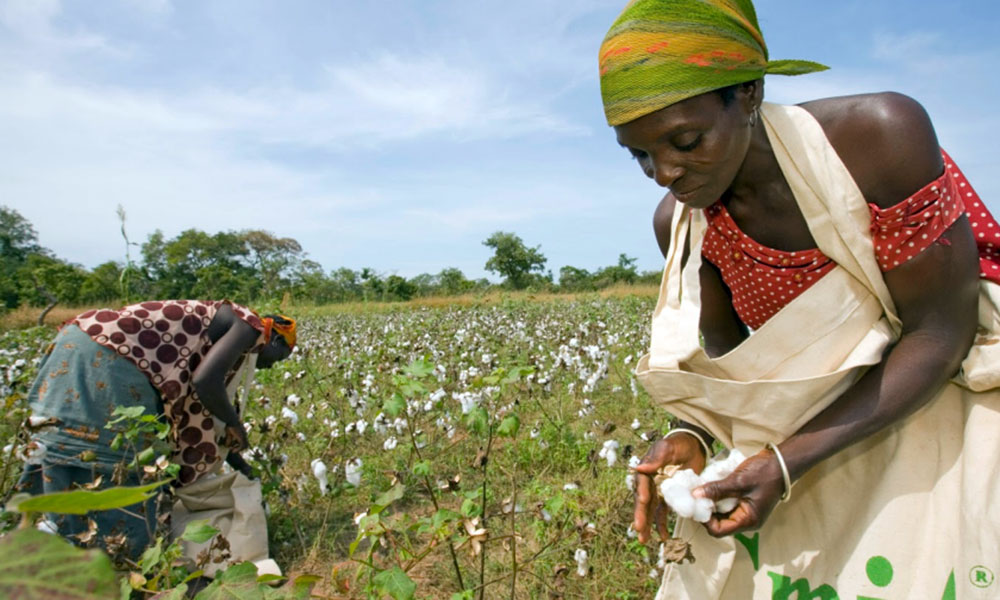
QUALITY: The Tanzanian farmers harvesting cotton.
DODOMA, Tanzania – A cross section of key cotton stakeholders, including buyers and outgrowers have met in Dodoma this month and set indicative price of cotton for this year’s season.
The seasonal indicative price is put in place as a mechanism to prevent farmers from incurring losses. This is a result of unscrupulous businessmen who buy cotton at lower prices compared to prices at the international market.
An indicative price also means farmers are not allowed to sell cotton below the Tsh750 ($0.446)/Kg threshold, while buyers are not permitted to purchase below the set price.
Mwanza Regional Commissioner Eng. Everest Ndikilo launched the cotton buying season for 2014/15, at Isole village, Sengerema District.
Ndikilo said they have agreed on an indicative price of cotton for the 2014/15 season at Tsh750 ($0.446) per kilogram.
Acting Managing Director for Tanzania Cotton Board (TCB), Gabriel Mwalo, said
stakeholders agreed on an indicative price for this season, which commences on June 18, 2014.
Cotton buyers are required to purchase above the indicative price. Any person who buys below the set price would be in contempt of rules and regulations governing the cotton industry, Mwalo said.
“We expect all concerned stakeholders to strictly adhere to procedures which are governed by the law, or else be in contempt of the Cotton Industry Act (Act No. 2 of 2001),” he said.
The process of getting an indicative price observed all criteria in a bid to protect benefits of stakeholders who are mainly farmers and buyers of cotton.
Since cotton is sold outside Tanzania in its raw form, criteria number one is the current international price.
He further said indicators include production costs, buying costs, transport costs, ginning costs, and contribution to the cotton development fund (district municipal tax).
Farmers through TACOGA prepare production costs while buyers under the umbrella of TCA come up with a price as well.
The government as an overseer does not decide on the indicative price. The stakeholders (farmers & buyers) agree on their own and the government through TCB advices by issuing a notice in a bid to get a common stand that has mutual benefits for both parties.
Cotton is a commercial crop that is grown in 15 regions spread across two zones which are Western which includes Mwanza, Shinyanga, Simiyu, Geita, Tabora, Mara, Kigoma, Singida and Kagera, while the Eastern zone has Morogoro, Iringa, Coast, Tanga, Kilimanjaro and Manyara.
The two geographical zones are different mainly in soil type, rain distribution, cotton diseases, pests and also beginning of the planting season.
Mwalo said the cotton planting season in the western zone begins in the middle of November while the Eastern zone starts from the beginning of February.
Due to this, harvesting of cotton commences at different periods which forces the cotton industry to put a procedure of launching the cotton buying period in June for the Western zone and September for the Eastern zone.
Cotton production for this season is estimated at 250,000 tones.
The stakeholders included cotton buyers through Tanzania Cotton Association (TCA), Tanzania cotton growers association (TACOGA), Ministry of Agriculture, Food Security and Cooperatives and Tanzania Cotton Board.
By Leonard Magomba, Saturday, June 21st, 2014