

Travel
Monday, May 12, 2014
Wa-Meru stick to traditions
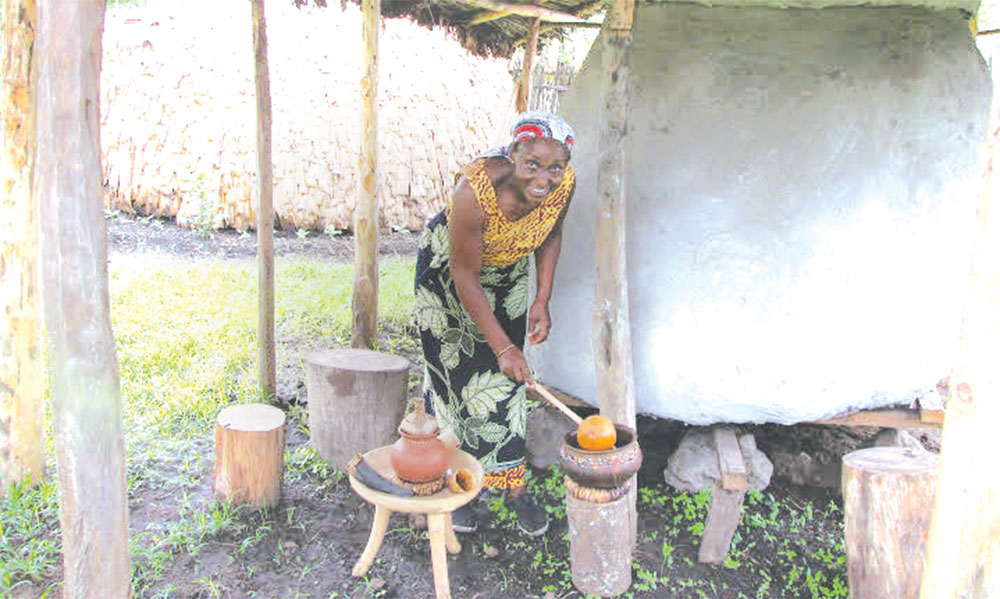
Mama Pallangyo displaying local Meru calabashes.
ARUSHA, Tanzania - About a 25 minute drive from Arusha town through Usa River, you will find Arusha’s most popular tourist attraction – ee-yeiyo Boma.
Located near the entrance gate of Arusha national park, Boma is surrounded by wilderness overlooking both Mount Meru on one side and the Usa river on the other.
The trail to the entrance gate is marked by bushes that line on both sides leading to where the treasure is hidden (the Boma). The scenery here is exotic, the air different and the stupendous view. The soft sounds of the river nearby can be heard. A reminder that one is temporarily removed from the hustle and bustle of a city life.
The first thing that one notices as you walk in is the huts within the compound that are covered with dry banana leaves, which appears in its exclusive khaki colours, and which manifest all through.
Recently, we paid a visit to this exotic place where we were met by the owner, Nkasiyoi Pallangyo. She invited us to sit on three-legged stools, offered tea served in horn cups and loshoro in wooden bowls.
She then took us on a tour of ee-yeiyo Museum, the domed house where rare artefacts, over one hundred years old, tell Wa-Meru history. We had a feeling of being back to the 19th century.
Ee-yeiyo story
Pallangyo lived abroad for over 23 years. Her late husband, Dr. Ephata P. Pallangyo worked with the Commonwealth Secretariat in London, U.K. Dr. E.P. Pallangyo is the author of the Book: “Environmental Concerns and the Sustainability of Africa’s Agriculture in the 1990s and Beyond.”
He later joined the Food and Agriculture Organization of the United Nations in Addis Ababa, Ethiopia where he taught at the International School. They also lived-in Harare, Zimbabwe and Nairobi, Kenya working for the same Organisation.
They often came back to their rural home in Sakila village. During these times Mama Pallangyo realised that most people preferred to converse in Kiswahili rather than Kimeru. Others did not see how Kimeru could be of any use to their children who did not even want to speak the language.
She said one woman openly laughed at her for giving her children Meru names telling her that when they grow up they will hate the names. She was so wrong.
She noticed that a lot of children and young people could not carry on a conversation in Kimeru. She was saddened by the fact that almost everyone, young and old, thought anything western is better.
She and her husband loved traditional food which she often prepared. She discovered that only a few people were interested in eating such dishes. Food that kept WaMeru healthy and free from debilitating illnesses.
By the time she started her collection she realised that most people had sold all of the precious wooden bowls, stools, gourds and other artefacts to tourists.
For these reasons Mama Pallangyo decided to do something about it when she and her husband retired.
She strongly believes that Meru’s history, culture and language are the identity. An identity that must be promoted and preserved for future generations.
“We should not let our children assume other peoples identity,” she quickly adds.
Mama Pallangyo, who often says ‘I love my culture – it is unique’, created ee-yeiyo Boma in 2010 to have a starting point where she can highlight WaMeru culture, sustain WaMeru language and have WaMeru history properly documented. She has plans for the future. She has started a special fund for the sustenance of the ‘RWA’ language (Kimeru).
She is also planning for an annual event that will bring together the whole of Meru- ‘The Nringaringa Festival.’
The festival will be under the stewardship of Cultural Tourism Programme office in Arusha, who she said have been very encouraging and supportive of ee-yeiyo enterprise. This event will bring in a lot of economic benefits for the entire Meru Community.
Fast facts:
Arusha, the safari capital of Tanzania, sits in lush, green countryside at the foot of Mt. Meru and surrounded by many coffees, banana plantations and maize estates tended by the locals mainly Wa- Meru and Wa-Arusha.
By Elisa Mayallah, Monday, May 12th, 2014